
Palate Expanders for Children in Bentleigh East
Jaw expansion treatment that looks at breathing, sleep and tongue function, not just crowded teeth.
Reviewed by: Dr Nomita Gonsalvez BDSc (Melbourne) | Post Grad Dip Orthodontics (London) | Grad Dip Dental Sleep Medicine (UWA) | Last reviewed: August 2026 |
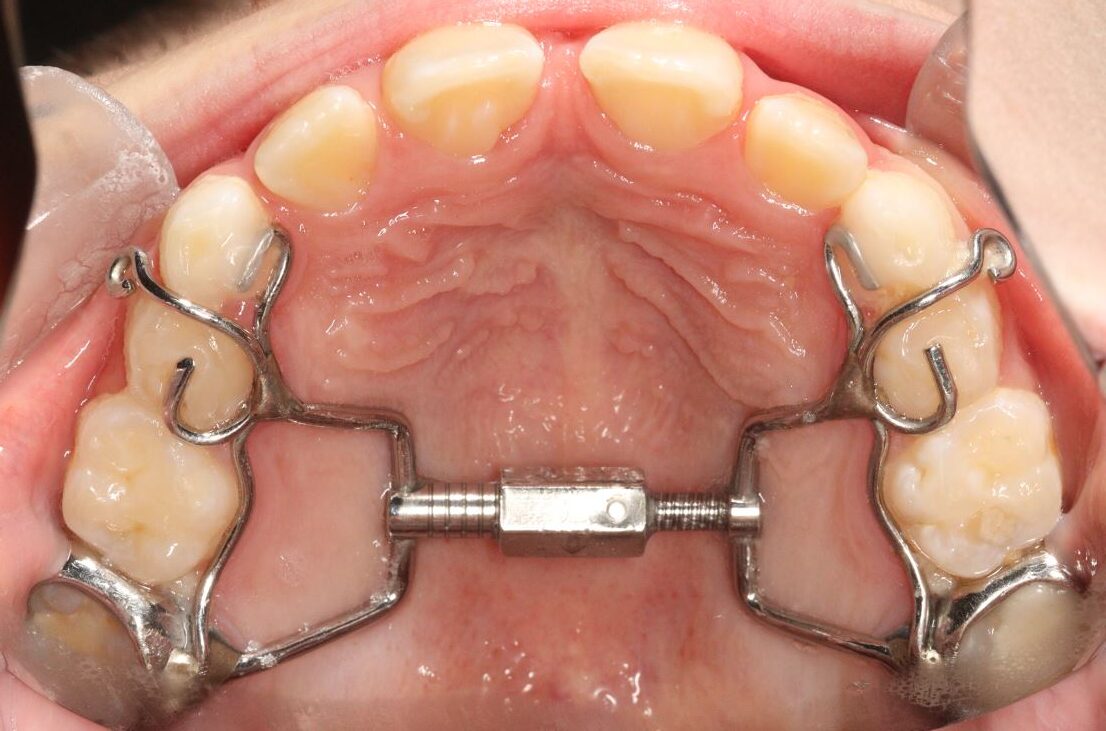
Why choose The Dental Gallery for your child’s palate expander?
- More then using a palate expander to widen the jaw: We also look at why the jaw is narrow, and what will help it stay wide. We look for the cause, not just the crowding. Every assessment checks breathing, sleep and tongue function as well as the teeth and jaws.
- Expansion and myofunctional therapy in one program: Your child’s expander and their tongue, breathing and swallowing training are planned together, in the same practice.
- 3D jaw and airway imaging on site: Low-radiation cone-beam CT (CBCT) shows the jaws, teeth and airway in detail.
- Coordinated care: We work with integrative medicine doctors and refer to ENT surgeons, sleep physicians and speech pathologists when your child needs them.
- Clear costs before you start: You get a written treatment plan and quote before treatment begins.
Palate expanders at a glance
| What is it ? | An orthodontic appliance that widens the upper jaw in growing children. |
| Who is it for ? | Children with a narrow upper jaw, crowding or crossbite |
| Best age ? | Most often from around age 7, after the first permanent molars come through. |
| How long ? | In most cases 6 to 9 months, followed by a retention phase. |
| Does it hurt ? | Most children feel pressure rather than pain, mainly in the first few days. |
How myofunctional therapy works with a palate expander
The tongue plays an important part in how the upper jaw grows. When a child’s tongue rests against the roof of the mouth, it applies light, steady pressure that helps the palate develop to its natural width. When a child breathes through their mouth, the tongue usually rests low in the mouth instead, and the upper jaw can develop narrower and higher. That’s why a narrow palate, mouth breathing, snoring and crowded teeth often appear together.
A palate expander widens the jaw, but it doesn’t change where the tongue rests or how your child breathes. If the habits that contributed to the narrow jaw continue, the jaw is more likely to drift back towards its original width.
Myofunctional therapy is a program of simple exercises that retrains the tongue, lips and face muscles: resting the tongue on the palate, breathing through the nose with the lips closed, and swallowing correctly. Alongside expansion, it helps your child make use of the extra space the expander creates and supports a more stable result.
What is palate (jaw) expansion treatment?
Palate expanders are orthodontic appliances that widen the upper jaw. They are used as an early orthodontic treatment for growing children, while the jaw is still developing.
At The Dental Gallery, Bentleigh East we select the right expander for each child based on:
- Their developmental age and growth stage
- Individual factors including compliance and temperament
- The degree of jaw expansion required
- The level of airway involvement
Signs your child may have a narrow jaw
A narrow upper jaw doesn’t only show up as crooked teeth. Many parents first notice something about the way their child breathes, sleeps or speaks.
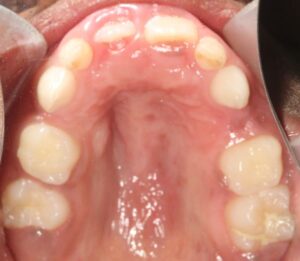
Teeth and jaw signs
• Dental crowding or a narrow palate
• Crossbite, where the upper teeth bite inside the lower teeth
• Impacted teeth
• Underdeveloped midface
Breathing, sleep and function signs
• Mouth breathing or snoring, even after tonsils or adenoids have been removed
• High narrow palate or narrow nasal passages
• Speech or feeding difficulties due to limited tongue space
• Restless sleep, bedwetting in older children or frequent ear infections. These can be linked
to disrupted breathing at night and are worth having assessed.
None of these signs on its own means your child needs an expander. They are a reason to have your child’s jaw, breathing and tongue function properly assessed.
Noticed two or more? Contact us for an appointment
Dental Gallery Bentleigh East Services
Inquiry? Contact Dr. Gonsalez
How does a palate expander work?
The upper jaw in children is made of two bones joined in the middle by a seam called the mid-palatal suture. Before puberty, this suture has not yet turned to solid bone. The expander is secured to the teeth, and a small screw in the centre is turned on a regular schedule.
This applies gentle, consistent pressure that encourages the two halves of the upper jaw to move apart. As they separate, new bone forms in the gap and the upper arch becomes wider. This is why timing matters so much.
The suture becomes harder to separate as the child gets older and it matures. This usually happens around or after puberty and varies from child to child, which is why we assess each child’s developmental stage rather than going by age alone.
Our approach: assess, expand, retain
The team at The Dental Gallery recognises that narrow jaws can also be linked to breathing and functional issues. We approach the diagnosis and management of narrow jaws to address more than dental crowding and crooked teeth. That’s why palate expansion here is part of a three-step program, not a single appliance.
1. Assess: look at factors that could be contributing a narrow jaw
• Comprehensive history taking
• Orthopaedic and orthodontic clinical assessment, including jaw size, jaw relationships, facial profile and posture
• If needed, low-radiation cone-beam CT (CBCT) imaging of the jaws, teeth and airway, including the position of the jaw relative to airway space and any impacted teeth
• Screening for sleep-disordered breathing
• Assessment of tongue posture and swallowing and chewing patterns
2. Expand: the right appliance for your child’s growth stage
Palate expander treatment is tailored to the needs of the child based on their developmental age. We choose between a fixed or removable expander, and a prefabricated or custom-made design, based on how much expansion is needed and what will work for your child day to day.
3. Retain and retrain
Expansion creates the space. Myofunctional therapy teaches the tongue, lips and breathing to use it (see “How myofunctional therapy works with a palate expander” above).
Your child’s program may include:
Tongue posture training
• Teaching your child the proper resting position of the tongue against the palate
• Correcting dysfunctional swallowing patterns
• Coordinating tongue posture with nasal breathing
Breathing retraining
• Daytime breathing training combined with integrative medical nasal breathing management
• Myofunctional aids to help practise nasal breathing
Facial muscle coordination
• Lip seal training to reduce mouth breathing
• Developing proper chewing and swallowing patterns without compensations
Coordinated care when your child needs more
Our team collaborates directly with integrative medicine doctors to coordinate care. Depending on your child’s needs, we can also refer to:
• ENT surgeon
• Paediatric sleep physician
• Breathing physiotherapist
• Speech pathologist for swallowing, speech and language development
• Other allied health practitioners.
Types of palate expanders
A palate expander sits inside the roof of your child’s mouth. Because every child’s palate is different, expanders are custom-made and fitted for each patient.
These are the 2 types we use most:
| Fixed: Rapid Palatal Expander (RPE) | Removable: Biobloc-style expander | |
| What it looks like | Metal, sits across the roof of the mouth with a small turning screw in the centre. Most parents describe it as a small metal bridge across the top of the mouth. |
Acrylic and metal, much like a standard retainer with a small screw built in. |
| How it stays in | Anchored to the back molars with metal bands. | Can be taken out for eating and cleaning. |
| Cleaning | Harder to clean. We recommend a water flosser. | Taken out to be cleaned, so easier to look after. |
| Day to day | Works without your child needing to remember to wear it. | Easier to misplace or break. A chat with your child’s teacher helps at school. |
Your Child's Treatment Journey Step by Step
Step 1: Children's Jaw & Airway Assessment
A comprehensive assessment and treatment planning process.
Step 2: Imaging and a personalised plan
Based on the assessments and advanced diagnostics, we determine a personalised plan to guide the ideal growth and development of your child.
Step 3: Digital scan
For a custom-made expander, we take a digital scan (hundreds of pictures of your kid’s teeth) to design and 3D print it. In some cases we will advise a prefabricated expander instead.
Step 4: Fitting
The expander is fitted and you and your child are given individual instructions.
Expect a few days for your child to adjust, with some changes to speech, swallowing and eating.
Step 5: Active expansion
The expander is widened gradually over a few months, guided by the space needed for the teeth, the tongue space and the breathing.
Step 6: Retention
Once the target width is reached, active expansion stops. Your child keeps wearing the expander as a retainer for an individualised period, then a custom retainer helps maintain the expansion.
Step 7: Myofunctional therapy
Runs alongside and after expansion to support tongue posture, nasal breathing and a stable result.
Step 8: Review for later treatment
When all the adult teeth are through (around 13 to 15 years), braces or clear aligners may still be needed to fine-tune the smile and bite.
About Dr Nomita Gonsalvez
BDSc (Melbourne) | Grad Dip Dental Sleep Medicine (UWA) | PG Dip Orthodontics (London) | Fellow, Pierre Fauchard Academy
Dr Gonsalvez is an airway-focused dentist with postgraduate a fellowship in dental sleep medicine in Bentleigh East, Melbourne, with over 25 years of clinical experience. Her practice focuses on the relationship between jaw development, breathing, and sleep health in both children and adults. She graduated from the University of Melbourne Dental School in 1998 (Dux Secondu) and holds postgraduate qualifications in orthodontics and dental sleep medicine. In 2023 she was inaugurated as a Fellow of the Pierre Fauchard Academy, an international honour recognising distinguished contribution to the dental profession.
Based in Bentleigh East, Melbourne, Dr Gonsalvez sees patients from across Bayside and southeast Melbourne including Moorabbin, Brighton East, Highett, Hampton East, Cheltenham, Carnegie, McKinnon, Waverley, Ormond, Murrumbeena, Oakleigh, Caulfield South, Malvern East and surrounding suburbs.
FAQs about Palate Expanders for Children
What is the best age for a palate expander?
• Palatal expansion can be done in children as young as 4 if there is a significantly narrow upper jaw or a significant skeletal (growth) issue affecting normal development.
• Starting young to modify growth also needs to be supported with proper function to maintain the change, so your child's ability to cooperate with the myofunctional part of the program matters too.
• Palatal expansion is a predictable treatment during the early stages of craniofacial growth. Once a child reaches puberty, the predictability of traditional expansion is reduced.
• We base treatment on developmental stage. For example, some girls are early developers, and traditional expansion may then cause unwanted tipping of the teeth rather than true skeletal expansion.
• If the suture is fused or close to fusing, expansion using mini-implants on either side of the suture can be more predictable. This is more involved and costly. We don’t offer this for older children, teenagers or adults, but we can refer you.
Will my child still need braces or extractions after a palate expander?
• Possibly. Expansion can reduce the need for extractions and make later treatment simpler, but many children still need braces or aligners to fine-tune the bite.
• Dental crowding is often a sign that the jaw has not grown enough, and is usually seen in children with narrow jaws.
• Expanding the jaw early, while the child is still growing, makes more space for the adult teeth. This can help reduce the need for extractions and the risk of impacted teeth and crowding-related problems.
• Combined with good retention and myofunctional therapy, expansion can make space for the adult teeth, restore tongue space for function and widen the nasal floor and to support breathing.
• Braces or clear aligners are used once the adult teeth are through, around 13 to 15 years.
Does a palate expander hurt?
• A palate expander does not typically cause pain, but your child will likely feel some pressure, especially in the first few days. Most children describe the feeling as pressure, not pain. The device gently pushes on the teeth and jawbone when first placed or adjusted, causing mild discomfort in some children.
How will a palate expander affect eating and daily life?
• Expect a few days of adjustment, then most children carry on as normal.
• Fitting is easy, but it takes a few days to adjust. Speech, swallowing and eating will feel different at first.
• A fixed expander is harder to clean, so we recommend a water flosser.
• A removable expander is easier to clean but easier to misplace or break, so a conversation with your kid’s teacher helps.
What can my child eat with a palate expander?
• Most children adjust to eating with an expander within a couple of weeks. We encourage a gradual return to a normal diet over a week.
• Avoid sticky foods like caramel, toffee and gummy lollies, which can pull at the appliance or wedge into tight spaces.
• Avoid hard foods like popcorn kernels, ice, pretzels and nuts, which can bend or break it.
• Cut crunchy foods like apples, celery and carrots into bite-sized pieces.
• Keep it clean: brush twice a day, floss daily and swish with water after eating.
How long does a palate expander stay in?
• In most cases a palate expander stays in for 6 to 9 months.
• The duration varies with your child’s age, jaw and teeth development, and how well they follow the treatment.
• Depending on the expander, a custom retainer is made after the expansion phase to maintain the result while any other orthodontic treatment continues.
Do I need to see a specialist orthodontist for a palate expander?
Dr Gonsalvez is a dentist with postgraduate training in orthodontics and dental sleep medicine. No referral is needed.
Is a palate expander covered by health insurance?
Many health insurance extras policies with orthodontic cover provide a rebate.
What is the research supporting early jaw expansion?
There is a large body of research in this field. These are some of the reviews that inform our approach, and we are happy to send you more resources.
• The role of rapid maxillary expansion in the promotion of oral and general health: https://www.ncbi.nlm.nih.gov/pmc/articles/PMC4596248/
• The role of pediatric maxillary expansion on nasal breathing. A systematic review and metanalysis: https://pubmed.ncbi.nlm.nih.gov/32502910/
• Effect of rapid maxillary expansion on sleep apnea-hypopnea syndrome in growing patients. A meta-analysis: https://pubmed.ncbi.nlm.nih.gov/31598206/
• Camacho et al., “Myofunctional therapy to treat obstructive sleep apnea: a systematic review and meta-analysis” (Sleep, 2015).
•Rapid maxillary expansion for pediatric obstructive sleep apnea: A systematic review and meta-analysis: https://pubmed.ncbi.nlm.nih.gov/27796040/